
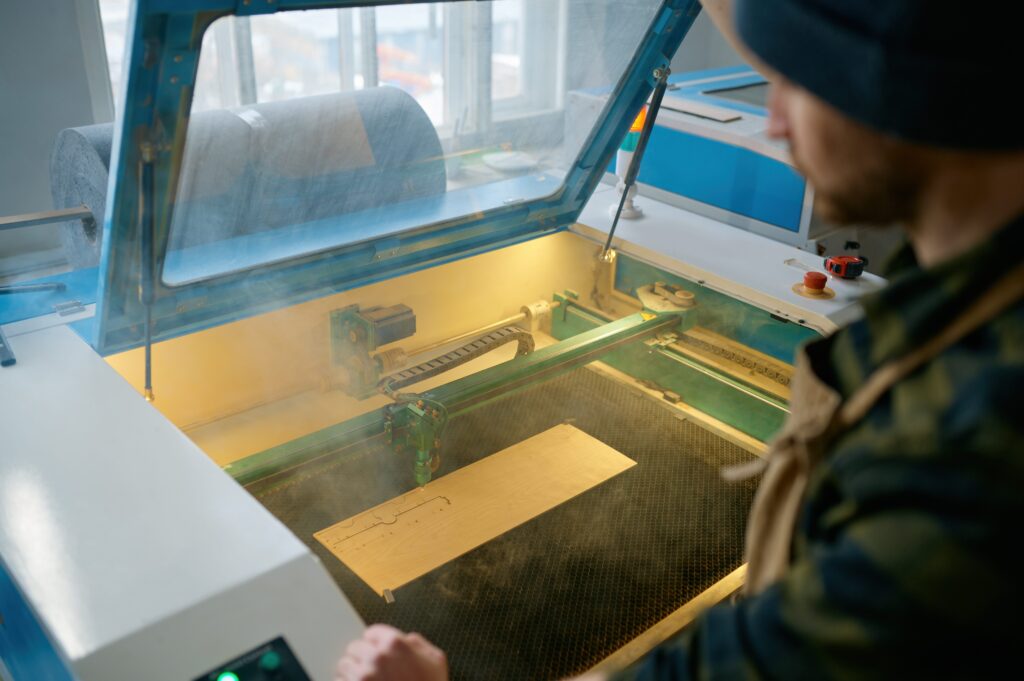
The basic principle of CO2 laser cutting
A CO2 laser excites a gas mixture to emit infrared light (~10.6 µm). The beam is focused to a small spot. In the cut zone, the material melts or vaporizes. An assist gas blows away the melt and keeps the cut clean. The kerf (width of cut) becomes small, saving material. If the focus is too high, the cut becomes wide and the edge becomes dull. If the focus is too low, the heat effect increases.
Immersion: energy absorption, focal length, HAZ and kerf
- Energy absorption: Organic materials absorb 10.6 µm effectively. Consequence: lower power is enough → finer edge.
- Length of focus (lens focal length): Short focus gives narrow kerf and high detail, but less tolerance to thickness variation. Long focus gives greater tolerance, but slightly wider kerf.
- HAZ (Heat Affected Zone = heat affected zone): More power or too low speed → greater HAZ and risk of yellowed edge in wood/plastic.
- notch: Typically from a few tenths of a millimeter. Increases with thickness, lower gas flow and incorrect focus.
Cause and effect: Increased power → faster cutting but larger HAZ. Therefore: increase speed or use nitrogen/air for cooler edge.
Materials & thicknesses
Which materials work best:
- Acrylic/PMMA: Clear edges, often polished surface directly. Thickness typically up to ~20-25 mm depending on effect.
- Wood/MDF: Fast cuts. Risk of yellowing/ burnt edge at low speed. Thickness typically up to ~15-18 mm.
- Textile/cardboard/leather: Very fast cuts, minimal mechanical impact.
- Thin metals: Thin stainless or steel sheet can be cut. Limit depends strongly on power and gas.
When CO2 is the right option
| Process | Strength | Restriction | Edge quality | Typical uses |
| CO₂ laser | Non-metals, thin metals, small radii | Less effective on shiny metals | Very good in plastic/wood | Acrylic signs, gaskets, decors |
| Fiber laser | Metals, high efficiency | Weaker on organic materials | Very good in metal | Sheet metal production, thin-medium thickness |
| Plasma | Thicker steel, lower cost per meter | Coarser kerf and HAZ | Coarse goods | Thick plate, rough cutting |
| Water jet | All materials, no HAZ | Slower, abrasive handling | Very good | Thick composites, heat sensitive |
Do you need help with laser cutting?
Send your drawings for a quote. We will get back to you with price, lead time and suggested parameters.