
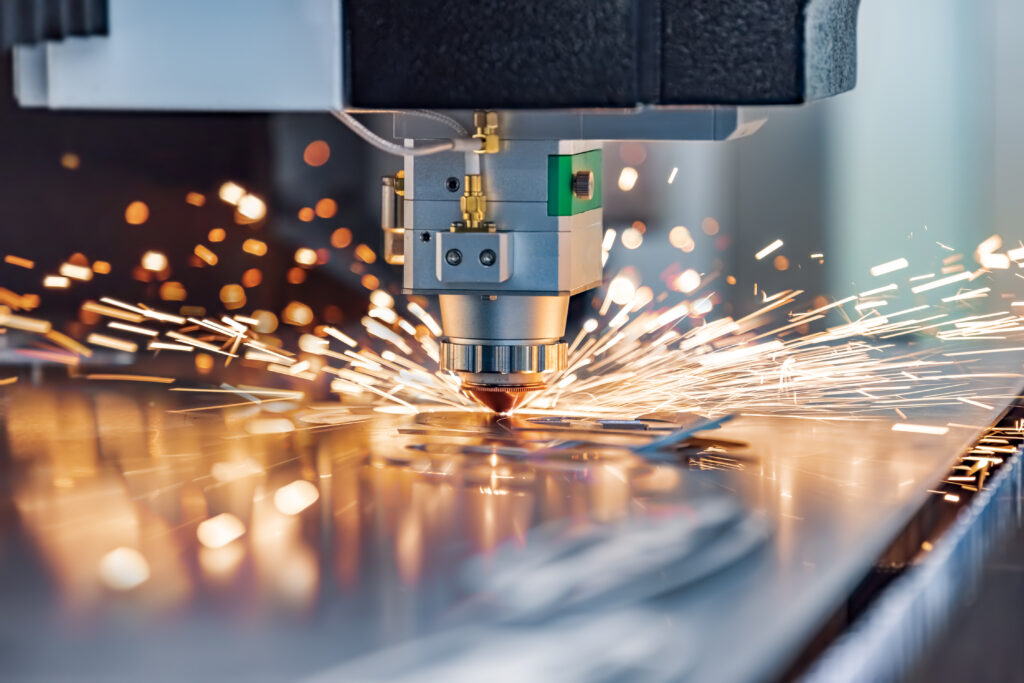
Fiber laser vs CO₂ vs plasma vs water
- Fiber laser
Strengths: Very energy efficient; fast in thin-medium thickness sheet metal; strong on Al/Cu/brass; narrow kerf.
Compromises: Edge finish in really coarse material thicknesses may require more fine trim; optics/protective glass require strict cleanliness.
- CO₂ laser (our method)
Strengths: Robust process window; can provide smooth, "soft" surface in coarse black steel with O₂; well proven in many standard steels.
Compromises: Lower power-to-light efficiency than fiber; less advantageous on highly reflective metals.
- Plasma
Strengths: Cost effective in heavy plate; high throughput.
Compromises: Wider kerf, larger HAZ, rougher edge-more finishing at tight tolerances.
- Water cutting
Strengths: "Cold" process without HAZ; can handle almost all materials/composites and very coarse thicknesses.
Compromises: Slower; high cost per meter in metal vs. laser; no heat advantage for plasticizing.
Materials & thicknesses for fiber lasers
Which materials work best:
- Black steel (S235/S355 and others): Very effective. With O₂ high rate is obtained via the exothermic reaction (oxide edge accepted). With N₂ cleaner edge, often slightly lower speed.
- Stainless steel (e.g. 304/316): Usually cut with N₂ for a shiny, low-oxide edge and minimal post-processing.
- Aluminum: Requires good beam quality, right focus and N₂ or compressed air; fiber laser handles Al well despite reflection.
- Copper/brass: High reflectivity and thermal conductivity, but fiber lasers (1.06 µm) work well with the right parameters and safety glass procedures.
When fiber laser is the right option
| Process | Strength | Restriction | Edge quality | Typical uses |
| Fiber laser | Metals (also Al/Cu), high efficiency, fast in thin-media | Less suitable for organic materials | Very good in metal | Sheet and tube production, series, tight tolerances |
| CO₂ laser | Non-metals, plastic/acrylic, wood, thin metal | Less effective on reflective metals | Very good in plastic/wood | Acrylic signs, gaskets, decor, sheet metal |
| Plasma | Rough sheet, lower cost per meter | Wide notch, larger HAZ | Coarse goods | Thick steel, rough cutting |
| Water jet | All materials, no HAZ | Slower, abrasive handling | Very good | Thick composites, heat sensitive |
Contact us for more information
Are you planning laser cut details? At Thor Ahlgren, we deliver CO₂ laser cutting with high and consistent quality in metal. We do not use fiber lasers, but are happy to share our experience so you choose the right method for edge, tolerance and lead time requirements.